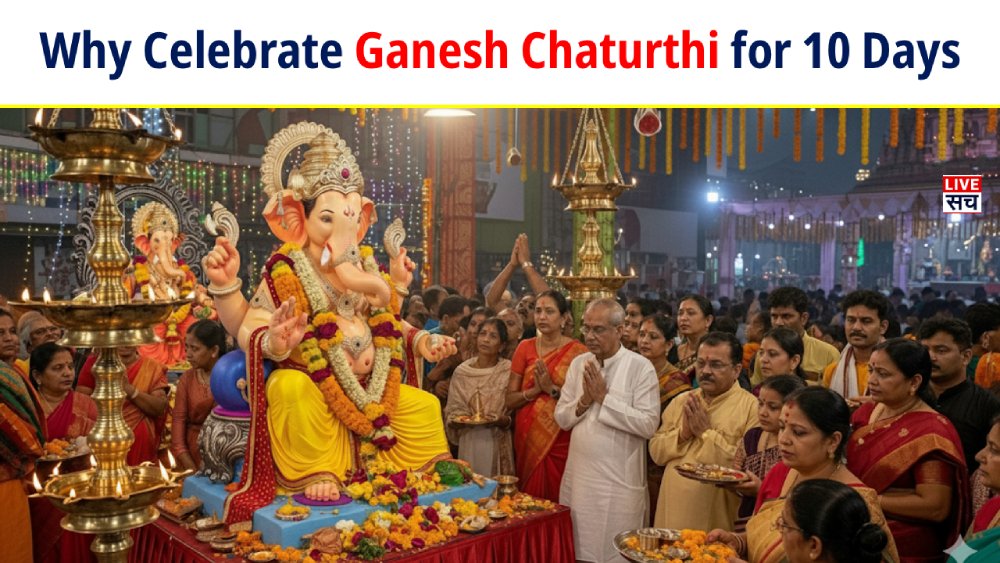
Every year, as the rhythmic beats of dhol-tasha fill the air, India immerses itself in the vibrant 10-day celebration of Ganesh Chaturthi. While we know this festival marks the birth of Lord Ganesha, the elephant-headed deity of wisdom and new beginnings, a question often arises: Why does the festivity last for precisely ten days? The answer is a fascinating blend of ancient mythology, a strategic political movement, and a profound philosophical lesson.
The Mythological Pact: A Divine Scribe and the Epic Mahabharata
The most compelling reason for the 10-day duration is tied to an epic tale of divine collaboration. After composing the massive epic of the Mahabharata in his mind, the great Sage Vyasa needed a scribe of immense intellect to write it down without pause. Lord Brahma suggested he seek the help of Lord Ganesha.
Ganesha agreed but set a strict condition: Vyasa must dictate the verses continuously without a break . In a brilliant counter, Vyasa added a condition of his own—Ganesha must understand the meaning of every verse before writing it . This created a perfect synergy. Whenever Vyasa needed a moment to rest or compose his thoughts, he would dictate an incredibly complex verse, forcing Ganesha to pause and contemplate its meaning . The legend states that this monumental task of documenting the entire epic took approximately ten days to complete.
This divine partnership explains the festival’s duration, transforming a cosmic intellectual endeavor into a living, yearly tradition.
The Historical Imperative: A Festival of Freedom
Historically, Ganesh Chaturthi was a private, family-centric affair, promoted by rulers like Chhatrapati Shivaji Maharaj to foster unity . However, under British rule, public gatherings were banned, causing the festival to retreat into the confines of homes .
In 1893, the prominent freedom fighter Lokmanya Bal Gangadhar Tilak transformed Ganesh Chaturthi into a public, or Sarvajanik, festival . He recognized that while political meetings were forbidden, religious events were largely tolerated. Tilak’s genius was in using the festival’s 10-day period as a strategic platform for nationalist speeches, patriotic songs, and intellectual discourse, uniting people from all castes and communities under the guise of devotion. The festival became a powerful tool for galvanizing India’s freedom struggle .
The Spiritual Cycle: From Creation to Dissolution
Beyond its historical and mythological roots, the 10-day festival represents a profound philosophical journey from form to formlessness.
- Sthapana (Creation): The festival begins with the ceremonial installation of the Ganesha idol in homes and public pandals. This ritual, known as Prana Pratishtha, invites the divine presence to reside within the clay idol, giving form to the formless.
- The 10 Days (Preservation): The ten days of continuous worship, with daily aarti and offerings, allow for a deep connection between the devotee and the divine form.
- Visarjan (Dissolution): The festival culminates on the final day, Anant Chaturdashi, with Visarjan, the immersion of the idol in a body of water. This is not a farewell of sadness but a joyous send-off, with chants of “Ganpati Bappa Morya, Pudhchya Varshi Lavkar Ya!” (“O Lord Ganesha, come early next year!”).
Symbolically, Visarjan serves as a powerful lesson in non-attachment and impermanence, reminding us that everything in this world is temporary . It is believed that as the idol dissolves, Lord Ganesha takes with him the obstacles and negativity of his devotees.
A Green Shift: A Modern Call for Responsibility
In recent times, the festival’s environmental impact has become a major concern. Traditional idols made from Plaster of Paris (PoP) contain harmful chemicals like mercury and lead and can take months to dissolve, polluting water bodies and harming aquatic life .
In response, a new wave of environmental consciousness has swept through the celebrations. Today, communities are embracing eco-friendly idols made from natural clay and promoting alternative immersion practices like using artificial ponds to minimize pollution. This shift demonstrates that the festival, once a tool for social and political change, continues to evolve to meet modern challenges.
The 10-day duration of Ganesh Chaturthi is more than a tradition; it’s a living symbol of a rich and multi-layered cultural heritage, uniting divine legend, national pride, and a timeless spiritual lesson.





Leave a Reply