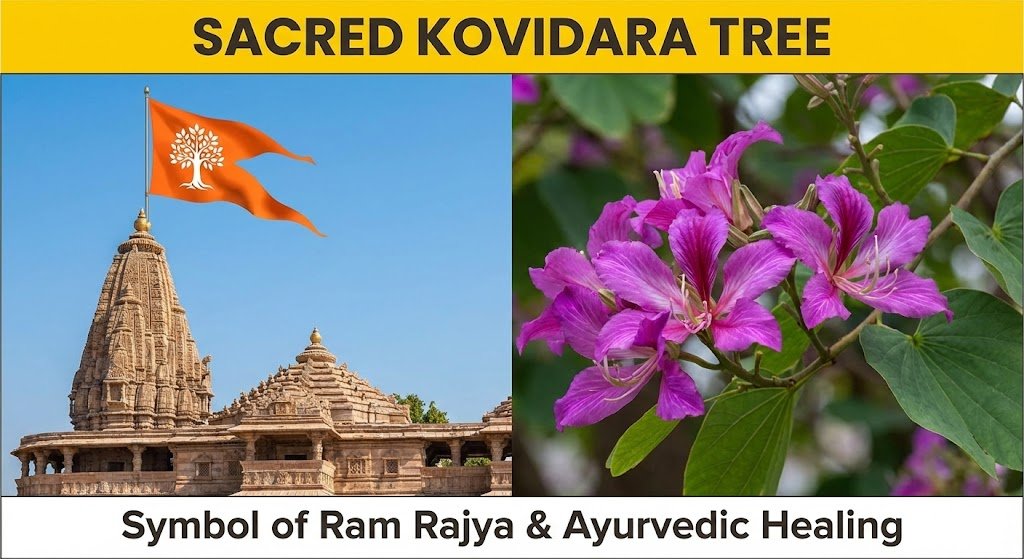
A botanical species that was once known only to Ayurvedic scholars and foresters has suddenly become India’s most searched term. The Kovidara tree (Bauhinia variegata) has moved from the forests to the forefront of national consciousness after it was featured prominently on the ‘Dharma Dhwaj’ hoisted at the Shri Ram Janmabhoomi Temple.
The historic flag-hoisting ceremony, led by Prime Minister Narendra Modi and RSS Chief Mohan Bhagwat on November 25, unveiled a saffron banner bearing three potent symbols: ‘Om’, the Sun, and the Kovidara tree.
Why the Kovidara?
While ‘Om’ and the Sun are universally recognized in Sanatan Dharma, the inclusion of the Kovidara tree sparked immediate curiosity. According to temple trustees and scholars, the tree was chosen for its deep-rooted symbolism in the Ramayana and the concept of Ram Rajya.
- The Bharata Connection: Ancient texts suggest that the Kovidara tree appeared on the flag of Bharata, the brother of Lord Ram, symbolizing loyalty, sacrifice, and governance rooted in dharma.
- Mythological Roots: Legends also describe the tree as a divine hybrid of the Mandar and Parijat trees, created by the sage Rishi Kashyapa.
Botanical & Medicinal Powerhouse
Beyond its symbolic weight, the Kovidara (commonly known as Kachnar or the Orchid Tree) is a powerhouse of utility.
- A “Doctor” in the Forest: In Ayurveda, the Kovidara is celebrated as a “Gandamala nashaka” (destroyer of glandular swellings). Its bark and root are critical ingredients in Kanchanara Guggulu, a classic formulation used to treat thyroid disorders, goiter, and lymphatic issues.
- A Culinary Delight: In many North Indian households, the unopened flower buds of the tree are harvested in spring to make Kachnar ki Sabzi and pickles, valued for their blood-purifying properties.
A Symbol of Environmental Resilience
Botanists have welcomed the spotlight on this native species. Unlike exotic ornamental trees, the Kovidara is drought-resistant, fixes nitrogen in the soil, and supports local pollinators with its vibrant, orchid-like purple blooms.
Its sudden elevation to a national symbol on the Dharma Dhwaj is being seen as a message to embrace India’s indigenous ecological heritage—a tree that heals the body, feeds the people, and now, symbolizes the state.





Leave a Reply