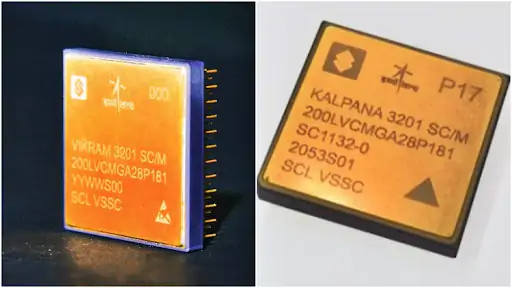
Delhi : At the Semicon India 2025 event in New Delhi, India unveiled its first fully indigenous 32-bit microprocessor chip, ‘Vikram’, developed by ISRO’s Semiconductor Laboratory (SCL) in collaboration with the Vikram Sarabhai Space Centre (VSSC). Union IT Minister Ashwini Vaishnaw handed the chip to Prime Minister Narendra Modi during the launch ceremony.
Designed for space missions, the Vikram chip can operate in extreme conditions, ranging from -55°C to +125°C, making it suitable for rocket launches and orbital operations. Built on 180nm CMOS technology, it was successfully tested onboard the PSLV-C60 mission’s POEM-4 module, powering the mission management computer with full reliability.

Key features of the Vikram chip include a 32-bit architecture, support for 64-bit floating-point operations, and a complete suite of indigenous software tools such as compiler, assembler, linker, and IDE. Alongside Vikram, ISRO also introduced the Kalpana 3201 microprocessor, a 32-bit SPARC V8 RISC chip compatible with open-source tools, and several other avionics devices.
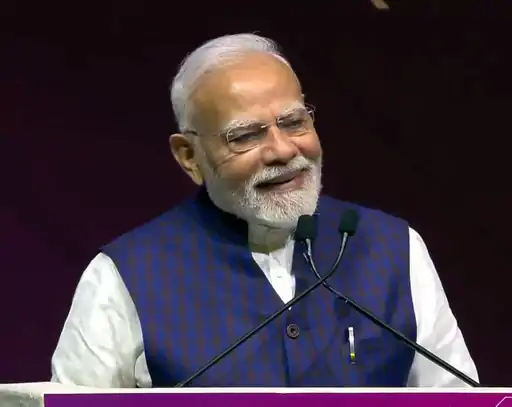
Inaugurating the three-day event, PM Modi emphasized India’s growing role in semiconductors, saying, “Earlier oil was called black gold, but now chips are digital diamonds.” The global semiconductor market, currently worth $600 billion, is expected to cross $1 trillion, and India aims to be a major player in this transformation.




Leave a Reply