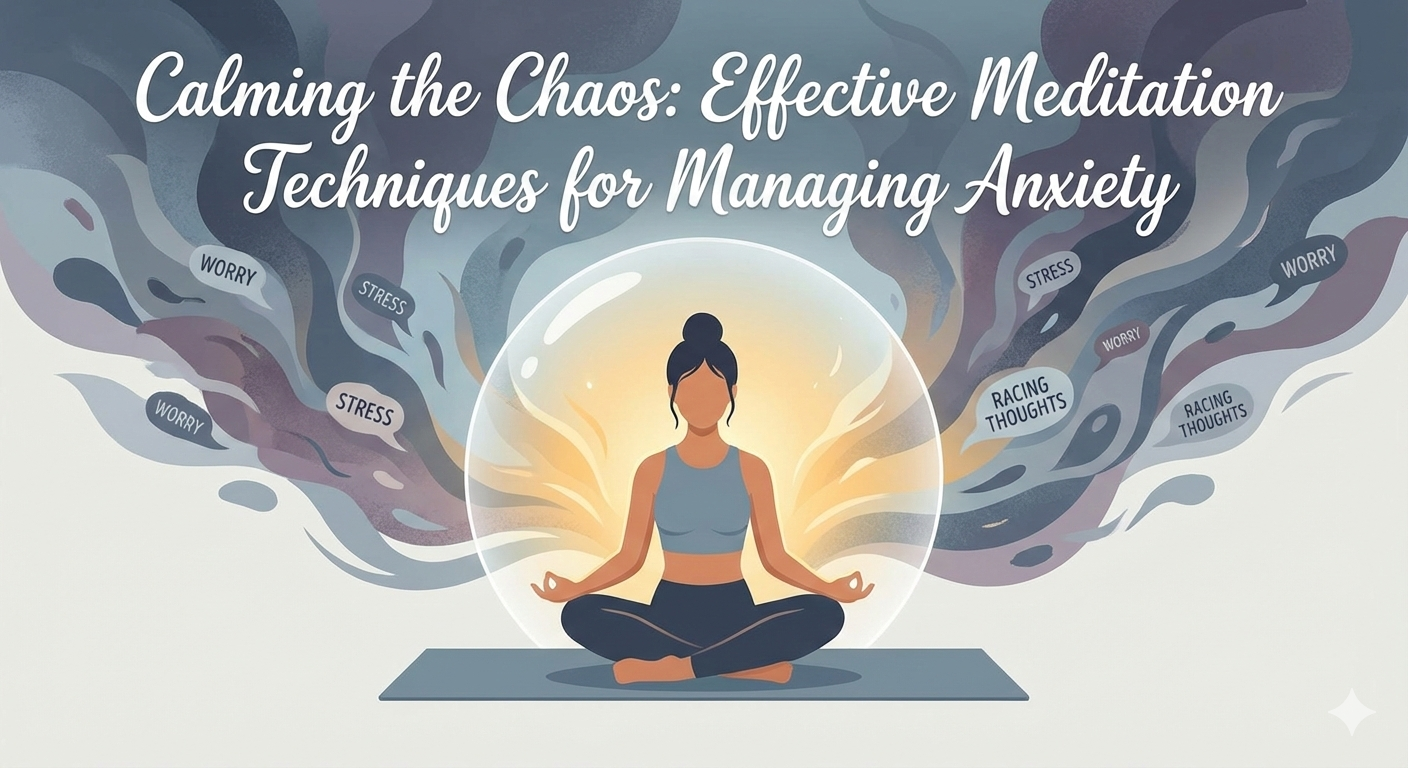
Anxiety often feels like a runaway train in your mind. The constant loop of “what ifs,” racing thoughts, and physical tension can be paralyzing. If you struggle with anxiety, you’ve likely been told to “just relax,” advice that is as frustrating as it is unhelpful.
True relaxation isn’t a switch you flip; it’s a skill you practice. This is where meditation enters the picture.
Meditation is not about emptying your mind or stopping your thoughts—an impossible task for an anxious brain. Instead, it is the practice of changing your relationship with your thoughts. It is learning to observe the chaotic traffic of your mind without stepping into the street and getting hit by a bus.
Here is a guide to understanding why meditation helps anxiety and five practical techniques you can start using today.
The Science Snack: Why Meditation Helps Anxiety
To understand why meditation works, we need to look at the nervous system.
Anxiety lives in the sympathetic nervous system—your body’s “fight, flight, or freeze” mode. When you are anxious, your body is flooded with stress hormones like cortisol and adrenaline, preparing you for a danger that often isn’t physical.
Meditation activates the opposing system: the parasympathetic nervous system, often called the “rest and digest” mode. Through deliberate focus and controlled breathing, meditation stimulates the vagus nerve, which sends a signal to your brain that you are safe. This slows the heart rate, lowers blood pressure, and physically forces the body to calm down, taking the mind along with it.
5 Meditation Techniques Tailored for Anxiety
When you are anxious, sitting in silence can sometimes make the noise in your head louder. Therefore, the best meditation techniques for anxiety usually involve an “anchor”—something specific to focus on to keep you tethered to the present moment.
1. Focused Breath Awareness (The Anchor)
This is the foundational practice of mindfulness. The breath is an ideal anchor because it is always with you and it occurs entirely in the present moment. You cannot inhale a future breath or exhale a past one.
How to do it:
- Find a comfortable seat. You don’t need to sit cross-legged on the floor; a chair is fine. Keep your spine relatively straight but not rigid.
- Gently close your eyes or soften your gaze toward the floor.
- Bring your attention to the physical sensation of breathing. Notice the cool air entering your nostrils or the rise and fall of your belly.
- Don’t try to change your breathing; just watch it.
- Crucial Step: Your mind will wander toward anxious thoughts. This is not a failure. The moment you notice your mind has wandered, gently, without judgment, escort your attention back to the next breath.
- Start with just 5 minutes a day.
2. The 5-4-3-2-1 Grounding Technique (The Emergency Brake)
This is less of a traditional “eyes closed” meditation and more of an active mindfulness exercise. It is incredibly effective for acute anxiety or the beginning of a panic attack because it forces your brain to engage with external reality rather than internal spiraling.
How to do it: Take a deep breath, look around your immediate environment, and silently name:
- 5 things you can see: (e.g., a lamp, a crack in the wall, the blue sky, your shoes, a plant).
- 4 things you can physically feel: (e.g., the fabric of your chair against your legs, the ring on your finger, the temperature of the air on your skin, your feet on the floor).
- 3 sounds you can hear: (e.g., distant traffic, the hum of the refrigerator, birds chirping).
- 2 things you can smell: (e.g., coffee, fresh air, laundry detergent).
- 1 thing you can taste: (e.g., the lingering taste of toothpaste, a mint, or just the inside of your mouth).
3. The Body Scan (Releasing Physical Tension)
Anxiety often manifests physically before mentally—tight shoulders, a clenched jaw, a churning stomach. The body scan helps you identify where you are holding tension and systematically release it.
How to do it:
- Lie down on your back in a comfortable position. Close your eyes.
- Take a few deep, grounding breaths into your belly.
- Bring your awareness to the toes of your left foot. Notice any sensations—warmth, coolness, tingling, or numbness.
- Imagine breathing into your toes, and as you exhale, imagine the tension dissolving.
- Slowly move your attention up your body—through your ankles, calves, knees, thighs, and hips—repeating the process of noticing and releasing.
- Repeat on the right leg, then move up through the torso, arms, neck, and finally, the muscles of the face and jaw.
4. Box Breathing (Square Breathing)
This technique is used by Navy SEALs and first responders to regulate their nervous systems in high-stress situations. It uses a rhythmic structure to override the shallow, rapid breathing that accompanies anxiety.
How to do it: Visualize a square. You will follow the four sides of the square with your breath.
- Inhale slowly through your nose for a count of 4.
- Hold that breath at the top for a count of 4.
- Exhale slowly through your mouth for a count of 4.
- Hold the empty breath at the bottom for a count of 4.
- Repeat this cycle for 3 to 5 minutes until your heart rate slows down.
5. Loving-Kindness Meditation (Softening the Inner Critic)
Anxiety is often fueled by harsh self-judgment and fear of not being “enough.” Loving-Kindness (or Metta) meditation is a practice of directing well-wishes toward yourself and others, acting as an antidote to negative self-talk.
How to do it:
- Sit comfortably and close your eyes.Take a few settle breaths.
- Silently repeat the following phrases to yourself, trying to connect with the intention behind the words:
- May I be safe.
- May I be peaceful.
- May I be healthy.
- May I live with ease.
- If it feels difficult to offer this to yourself, imagine a loved one or even a beloved pet, and offer the phrases to them first, then gently turn them back to yourself.
A Final Tip for the Anxious Meditator
If you try meditating and feel like your brain is screaming at you, know that this is normal.
The goal of meditation is not to achieve a perfectly silent mind. The “rep” in the mental gym—the moment the muscle gets stronger—is the exact split second you realize your mind has wandered and you choose to bring it back to the anchor.
If you do that 100 times in a 10-minute session, that is 100 moments of success, not failure. Be patient with yourself; managing anxiety is a marathon, not a sprint.





Leave a Reply