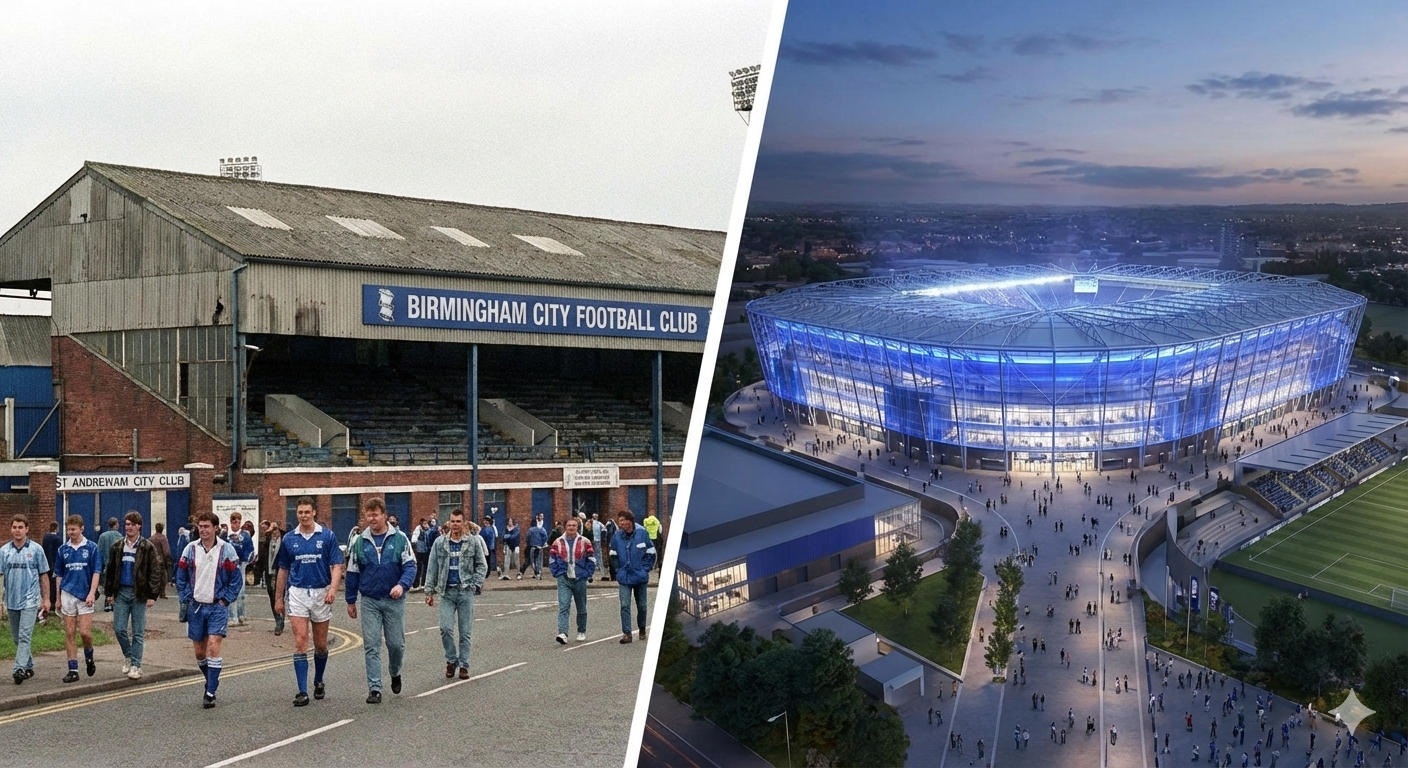
St Andrew’s, postcode B9. For fifty years, it had been the tapestry of Arthur’s life. It smelled faintly of burnt onions, damp concrete, and the collective nervous energy of twenty thousand people. He knew which step cracked on the way up to the Tilton, and precisely where the roof leaked in the Main Stand when the November rains came sideways. It was home. It was tired, glorious, frustrating home.
His grandson, Leo, only ten years old, tugged his sleeve. They weren’t at St Andrew’s today. They were standing on a viewing platform overlooking a vast, desolate stretch of brownfield land in East Birmingham—the former Wheels site.
“Is this really it, Grandad?” Leo asked, squinting against the grey Midlands sky. “It’s just mud.”
Arthur smiled, wrapping his scarf tighter. “It’s mud now, lad. But it’s the future.”
The news had hit the blue half of the city like a seismic shock. For years, the narrative around Birmingham City had been about survival—fixing broken stands, dodging relegation, managing decline. But the new ownership hadn’t come to patch up the leaks. They had arrived with a wrecking ball and blueprints for a palace.
They weren’t just talking about a stadium; they were talking about a “Sports Quarter.” A multi-billion pound investment that promised a world-class arena, training facilities, and a regeneration effort that would reshape an entire corner of the city.
Arthur pulled out his phone and brought up the artist’s impressions that had been released. He showed Leo the screen. The image showed a shimmering colossus of steel and glass, glowing an ethereal sapphire blue in the evening light. It was sleek, intimidating, and undeniably modern. It promised sixty thousand seats, acoustics designed to trap noise like a cauldron, and facilities that rivaled the giants of Europe.
“Look at that,” Arthur whispered, a tremor in his voice that wasn’t from the cold. “That’s for us, Leo. Not Manchester, not London. Birmingham.”
Leaving St Andrew’s would be a wrench of the heart. The ghosts were there—the magic of Trevor Francis, the flair of Dugarry, the roar of the Carling Cup win. That soil held memories that couldn’t be transferred by truck.
But Arthur looked back at the muddy expanse in front of them. St Andrew’s was the past—a beloved, complicated past. This site, this blank canvas, was the declaration of intent. It was a statement that Birmingham City was finished with being the sleeping giant, content to doze in the shadows of the Second City.
“Will it still feel like ours?” Leo asked, looking at the futuristic picture on the phone and then back at the gritty reality of the construction site.
Arthur rested his hand on his grandson’s shoulder. “Brick and mortar don’t make a club, Leo. We do. The noise we make. The way we keep right on to the end of the road.” He looked out over the horizon where the new structures would rise. “They are building the body, son. We will bring the soul.”

Leave a Reply