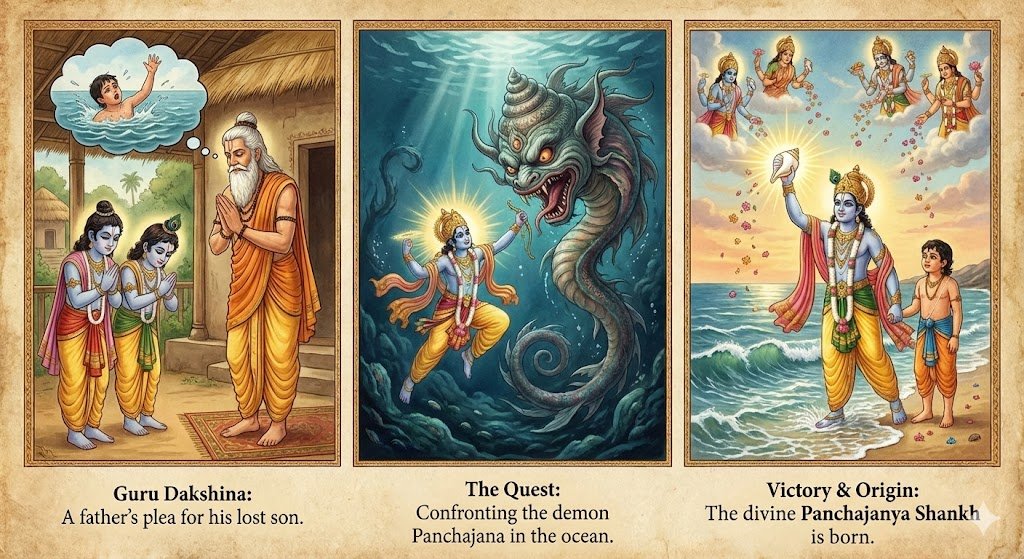
While most devotees know the story of Krishna slaying the demon Panchajana to acquire his divine conch, ancient scriptures reveal that the Panchajanya was far more than a war trophy. It was a sentient instrument with specific physical attributes, a code language for war, and deep cosmic symbolism.
Here are the fascinating details often missed in standard retellings.
1. The Physical Description: “White as Milk”
According to the Harivamsha and the Mahabharata, the Panchajanya was not an ordinary shell. It is poetically described as being “as white as cow’s milk” (Kunda-indu-savarnam) and radiating a brilliance equal to the full moon.
- The Golden Net: In several texts, the conch is described as being covered in a golden lattice or net (hemajala-parishkritam) and studded with precious gems, distinguishing it as the King of Conches (Shankharaja).
2. The “War Codes” of Kurukshetra
During the 18-day Mahabharata war, the Panchajanya was used as a sophisticated signaling device, not just a noise-maker.
- The Distress Signal: Krishna and his charioteer had a specific code. If Krishna blew the Panchajanya in a particular rhythm during a chaotic battle, it was a signal that Arjuna was in mortal danger and needed immediate reinforcement.
- The “Sunset” Signal: The conch was blown at the end of every day to signal the ceasefire. However, on the 14th day, Krishna famously used the environment and the conch to create an illusion of sunset to trick Jayadratha, leading to his death at Arjuna’s hands.
3. The “Two Origins” Mystery
While the popular story involves the demon Panchajana and Guru Sandipani, the Skanda Purana offers an alternative or dual origin.
- Samudra Manthana: It states that the Panchajanya was actually one of the divine Ratnas (jewels) that emerged during the Churning of the Ocean (Samudra Manthana), appearing alongside the Goddess Lakshmi and the Kaustubha gem.
- Reconciliation: Scholars often interpret this to mean that the conch returned to the ocean after the churning and was later inhabited by the demon Panchajana before being reclaimed by Krishna.
4. The Meaning of “Pancha-Janya”
The name itself holds a double meaning rooted in Sanskrit:
- Pancha-Jana (The Demon): Literally “born from Panchajana.”
- The Five Elements: Spiritually, it represents the control over the Five Elements (Earth, Water, Fire, Air, Space) and the Five Senses.
- Bhagavad Gita Reference: In Chapter 1, Verse 15, the text specifically links the conch to Krishna’s sensory mastery:“Panchajanyam Hrishikesho…” (Hrishikesha [Master of the Senses] blew the Panchajanya…)
5. Where is it Now?
According to the Mausala Parva of the Mahabharata, when Lord Krishna ended his earthly avatar and ascended to Vaikuntha, he cast his divine weapons—the Sudarshana Chakra and the Kaumodaki Gada—back into the ocean. It is believed the Panchajanya also returned to the depths of the cosmic ocean, awaiting the arrival of the Kalki Avatar to be sounded once again.





Leave a Reply