Ask a Gen Z student how many paise make a Rupee, and the answer is an immediate “100.” It is a decimal fact as fundamental as 10 millimeters in a centimeter. But for the generation that grew up in the early days of independent India, the math wasn’t so simple.
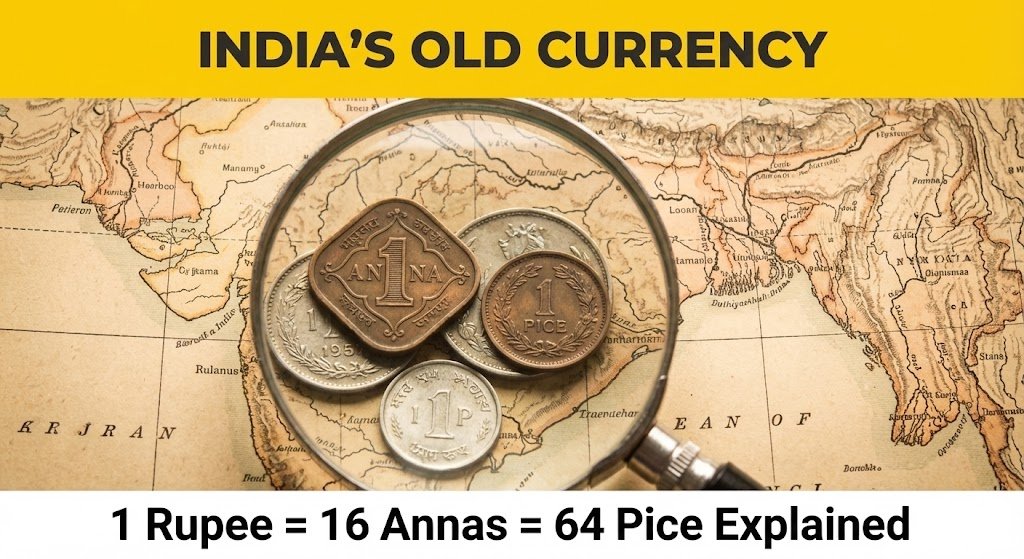
Before the landmark shift in 1957, the Indian currency system was a complex, non-decimal web that baffled foreigners but was second nature to locals. The answer to “How many paise make a Rupee?” before 1957 was not 100. It was 64.
The Era of ‘Solah Aane’
Until April 1, 1957, the Indian Rupee followed the British system of weights and measures, which was duodecimal and quaternary rather than decimal. The currency was anchored by the Anna.
The breakdown was specific:
- 1 Rupee = 16 Annas
- 1 Anna = 4 Pice (Old Paise)
- 1 Pice = 3 Pies
Therefore, doing the math (16 x 4), one Rupee consisted of 64 Pice (or Paise).
This system is why the Hindi idiom “Solah Aane Sach” (Sixteen Annas True) exists. It translates to “100% Truth” because 16 Annas made a whole Rupee. If something was “8 Annas,” it was half; “4 Annas” (or a Chawanni) was a quarter.
The Great Switch of 1957
The complexity of the Anna system—calculating interest, taxes, and international trade—became a hurdle for a modernizing nation. In 1955, the Indian Parliament passed the Indian Coinage (Amendment) Act to introduce the decimal system.
On April 1, 1957, the “Naya Paisa” (New Paisa) was introduced.
- Old System: 1 Rupee = 64 Pice
- New System: 1 Rupee = 100 Naya Paise
For a few years, both currencies circulated simultaneously, leading to confusion in marketplaces. People had to carry conversion charts to understand that 1 Anna was roughly equal to 6 Naya Paise. Eventually, the “Naya” was dropped from the name in 1964, and it simply became the “Paisa” we know today.
A Fading Legacy
Today, the 64-pice Rupee is a collector’s item. The old coins—with their unique shapes, including the square 2-Anna coin and the scalloped 1-Anna coin—are relics of an era where mental math required dividing by 16 rather than 10.
While the coins have vanished from circulation, they remain embedded in the language. When an elder says something is worth “Do Kaudi,” they are referring to the cowrie shells that were once even smaller denominations than the Pie. But for the history books, the definitive fact remains: Before the dawn of the decimal in 1957, the Indian Rupee was a sum of 64 parts, not 100.





Leave a Reply