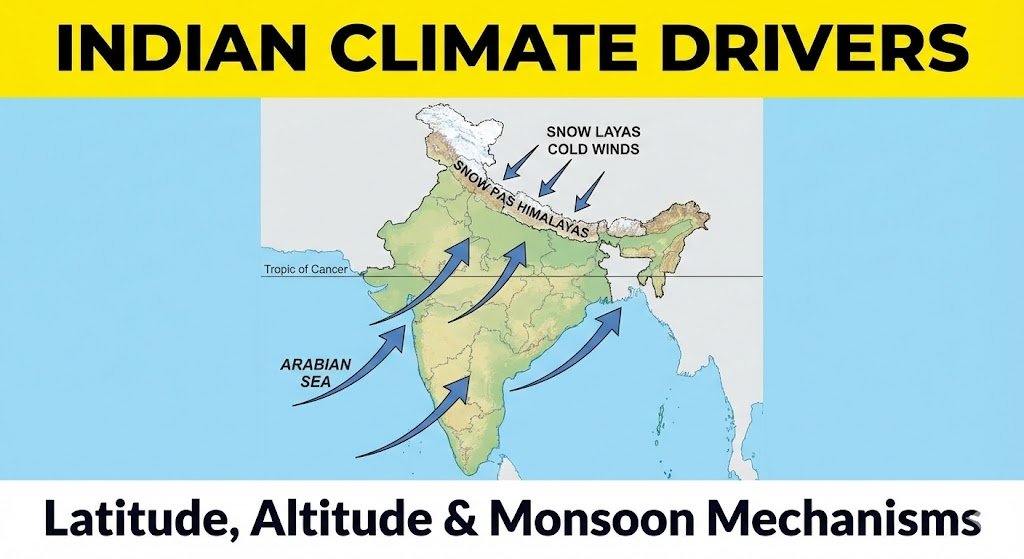
As India witnesses increasingly unpredictable weather patterns—from searing heatwaves in the northern plains to intense cloudbursts in coastal regions—meteorologists and geographers are urging a deeper public understanding of the fundamental mechanics at play.
While climate change is the current accelerator, the foundational blueprint of India’s weather is dictated by six powerful geographic and atmospheric “controls.” Understanding these factors is crucial to comprehending why a single country experiences arctic cold, desert heat, and tropical humidity simultaneously.
According to India Meteorological Department (IMD) scientists and geography experts, India’s climate is not random; it is a complex system governed by specific fixed and variable factors.
The Fixed Geographic Anchors
The first major control is Latitude. The Tropic of Cancer passes roughly through the middle of the country. “This geographical reality divides India,” explained Dr. Aruna Sharma, a senior climatologist. “Areas south of this line are in the tropical zone, experiencing high temperatures year-round, while the north lies in the subtropical zone, giving it distinct winter seasons.”
Closely linked to this is Altitude. Despite being in a warm latitude, hill stations like Shimla or Ooty remain cool. The rule is simple: for every 165 meters of ascent, the temperature drops by roughly 1°C.
The Himalayan Shield
Perhaps the most critical feature unique to the region is Relief, specifically the mighty Himalayas.
“If the Himalayas didn’t exist, the climate of North India would be drastically different,” Dr. Sharma noted. “These high mountains act as a climate barrier. They block frigid winds from Central Asia from entering India, keeping our winters relatively mild. Conversely, they trap the moisture-laden monsoon winds within the subcontinent, forcing them to shed rain over North India.”
The Engine of Wind and Water
The dynamic aspect of India’s climate is driven by Pressure and Wind Systems. The entire monsoon mechanism is based on differential heating. In summer, the Indian landmass heats up quickly, creating low pressure, while the surrounding seas remain cool with high pressure. This causes moisture-carrying winds to rush from the sea to the land, creating the Southwest Monsoon.
This dynamic is further influenced by the Distance from the Sea. Coastal cities like Mumbai have an ‘equable’ climate with little variation in temperature. In contrast, interior cities like Delhi, far from the moderating influence of the ocean, experience ‘continental’ climate extremes—very hot summers and biting cold winters.
The Upper Atmosphere Influence
Finally, experts point to the role of Jet Streams—fast-flowing bands of air in the upper atmosphere. The position of the subtropical westerly jet stream determines the arrival of western disturbances in winter, crucial for rabi crops, while the easterly jet stream plays a role in steering tropical depressions during the monsoon.
As India adapts to a changing global environment, these six fundamental controls remain the essential framework for understanding the subcontinent’s meteorological heartbeat.





Leave a Reply