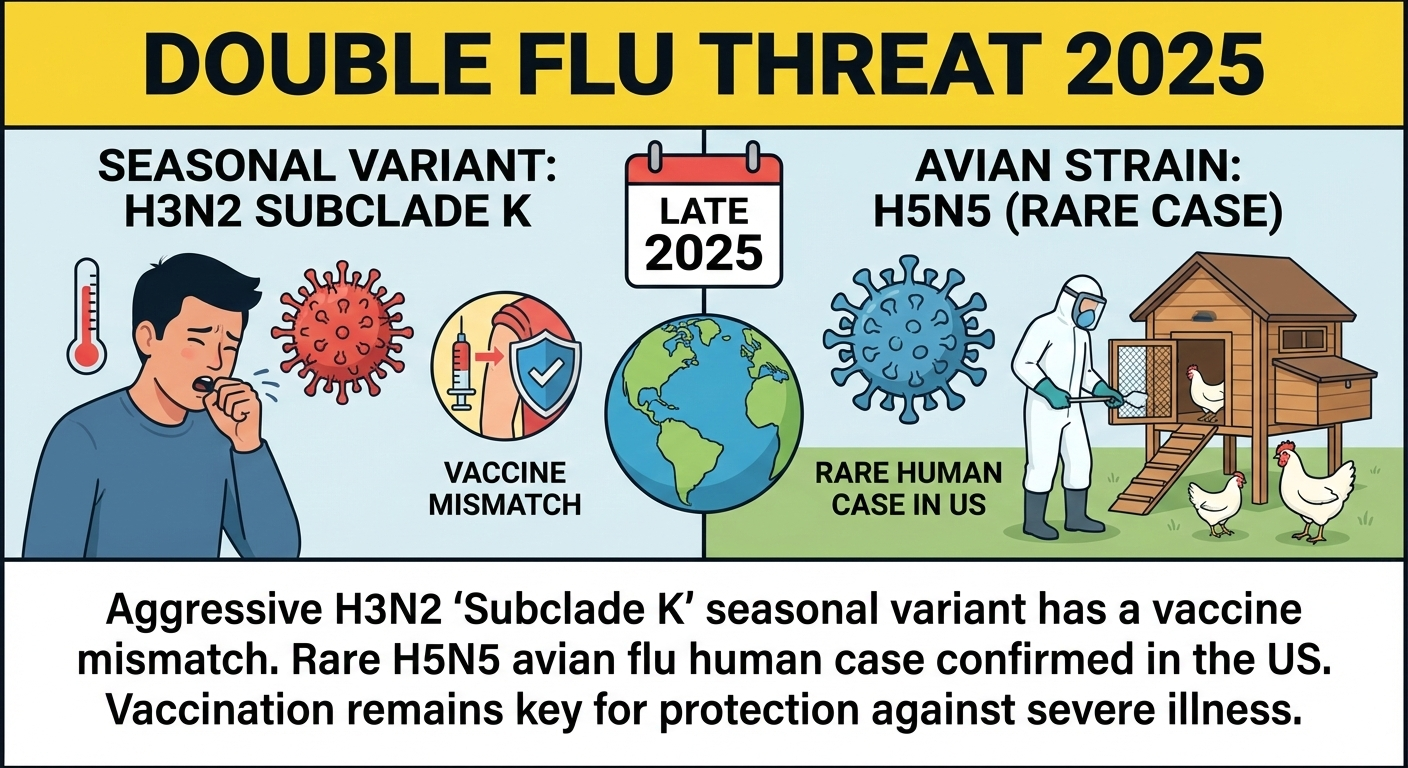
As the Northern Hemisphere settles into the 2025-2026 respiratory virus season, health authorities are grappling with a complex dual challenge. Public attention is currently divided between a rapidly evolving seasonal influenza variant that is driving aggressive outbreaks globally, and the novel detection of a rare avian influenza strain in a human patient in the United States.
While the avian case is drawing headlines for its novelty, experts warn that the mutated seasonal strain poses the far greater immediate threat to public health.
The Main Threat: H3N2 “Subclade K”
The primary concern for the general public this winter is a specific mutation of the seasonal Influenza A virus, known technically as H3N2 subclade K.
Unlike typical seasonal flu strains that drift gradually, Subclade K mutated rapidly over the summer of 2025. This aggressive variant has already been identified as the driver behind early and severe flu outbreaks in the United Kingdom, Japan, and Canada.
Historically, flu seasons dominated by H3N2 strains tend to be more severe, particularly for older adults and younger children. The rapid spread of Subclade K internationally suggests a potentially difficult winter ahead for the United States healthcare system.
The Vaccine “Mismatch” Explained
The speed at which Subclade K emerged has created a significant challenge for this season’s vaccination effort.
Influenza vaccines must be formulated months in advance. The 2025-2026 flu shots were designed in early 2025 to target the strains dominant at that time (specifically “Subclade J” variants). Because Subclade K emerged later, there is now a documented “mismatch” between the virus currently circulating and the vaccine designed to stop it.
However, health officials are aggressively pushing back against the idea that the vaccine is useless.
While the mismatch means the vaccine may be less effective at preventing initial infection and mild symptomatic illness, data indicates it still provides robust cross-protection against the worst outcomes. Experts emphasize that receiving the current flu shot remains the single best defense against severe illness, hospitalization, and death caused by H3N2.
The Avian Anomaly: H5N5 in Washington
Adding complexity to the viral landscape is news from Washington state, where health officials confirmed the first-ever human case of H5N5 avian influenza in the United States in November 2025.
It is crucial to distinguish this from the H5N1 “bird flu” strain that has affected dairy cattle and poultry in recent years. The H5N5 case occurred in an individual with direct exposure to an infected backyard flock.
Officials state that the risk to the general public from H5N5 remains low. There is currently no evidence of human-to-human transmission. This case is being treated as a rare spillover event rather than the start of a new pandemic threat.
Navigating the Season: Official Recommendations
Facing an aggressive seasonal variant, health agencies are doubling down on standard preventative advice.
Despite the H3N2 mismatch, the Centers for Disease Control and Prevention (CDC) continues to recommend the trivalent flu vaccine for everyone aged six months and older. The current vaccine protects against three standard lineages:
- A/Victoria/4897/2022 (H1N1)pdm09-like virus
- A/Croatia/10136RV/2023 (H3N2)-like virus (the older strain)
- B/Austria/1359417/2021 (B/Victoria lineage)-like virus
Furthermore, officials remind the public that antiviral treatments, such as Tamiflu, remain highly effective against these new seasonal strains if taken within the first 48 hours of symptom onset.
In light of the aggressive nature of Subclade K, vulnerable populations are being advised to practice heightened hygiene protocols, including frequent hand washing and considering mask usage in crowded indoor spaces during peak season.





Leave a Reply